Nano Banana, Close Enough
Dr. Philippa Hardman has written an excellent article on using Google’s Nano Banana AI image generation tool to support learning. The piece outlines six evidence-based use cases that go far beyond simple infographics: visualization, analogy, worked examples, contrasting cases, elaboration, and generation. Each strategy is grounded in decades of cognitive and educational research, and Hardman provides concrete prompts that instructional designers can immediately put to use.
The article also reinforces a critical lesson I’ve learned from my own experiences with AI: often it’s close enough, but it’s critical to review the outputs carefully.
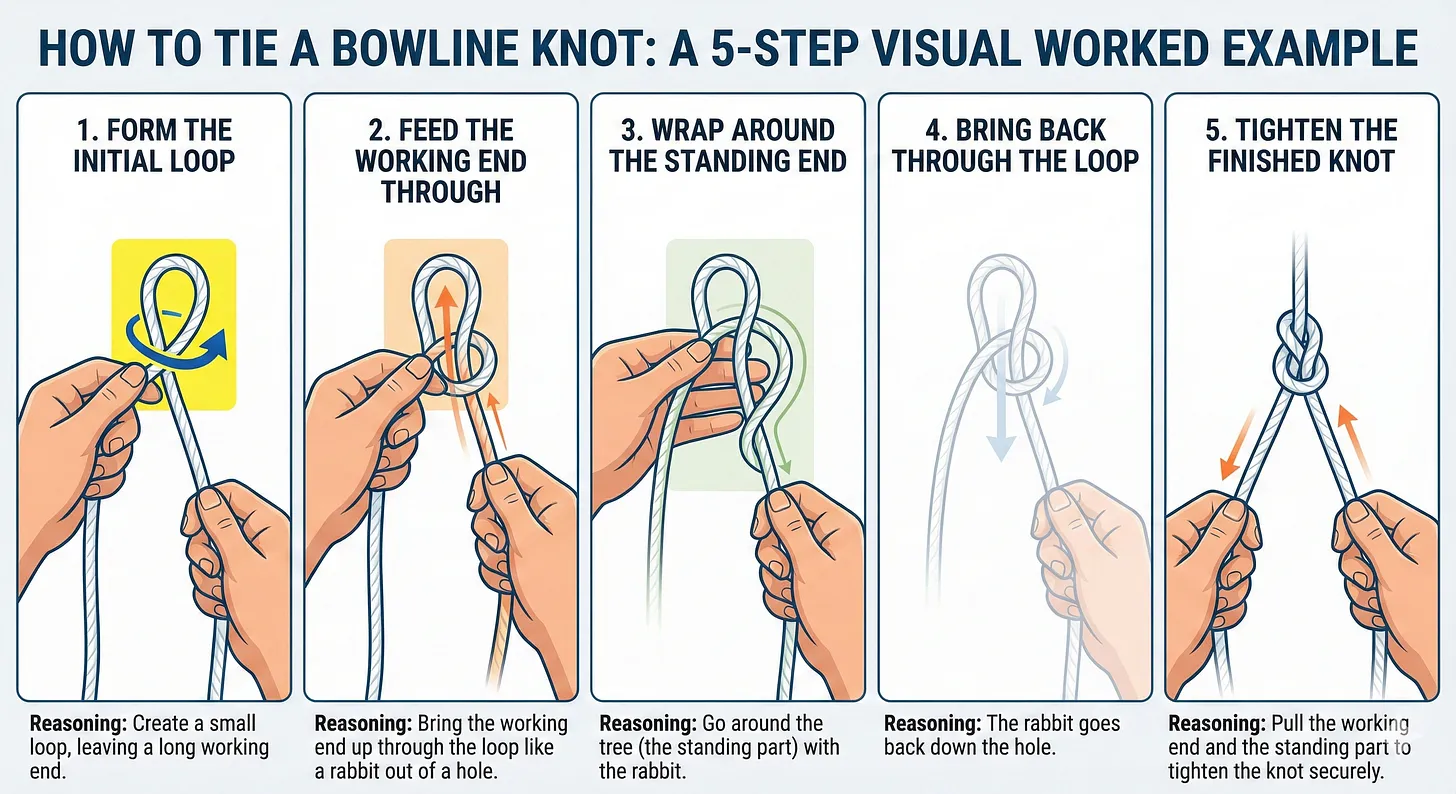
Take, for example, the worked example image that Hardman includes in their article—a 5-step visual guide for tying a bowline knot. The bowline is a fundamental knot used in countless situations, from sailing to rescue operations to everyday tasks. When tied correctly, it’s reliable and secure. When tied incorrectly, it can fail catastrophically.
The Nano Banana-generated image contains errors in the knot-tying sequence. This isn’t a criticism of Hardman’s work. They are using it as an example of the tool’s capabilities, not as a knot-tying tutorial, but rather a reminder that even when AI produces something that looks professional and well-organized, domain expertise and careful review remain essential. As a sailor, I spotted the mistake immediately.
So yes, use Nano Banana to create worked examples, visualizations, and contrasting cases. But always review the outputs with the same professional rigor you’d apply to any instructional material. Because when it comes to teaching and learning, “close enough” isn’t good enough.